
Diseases
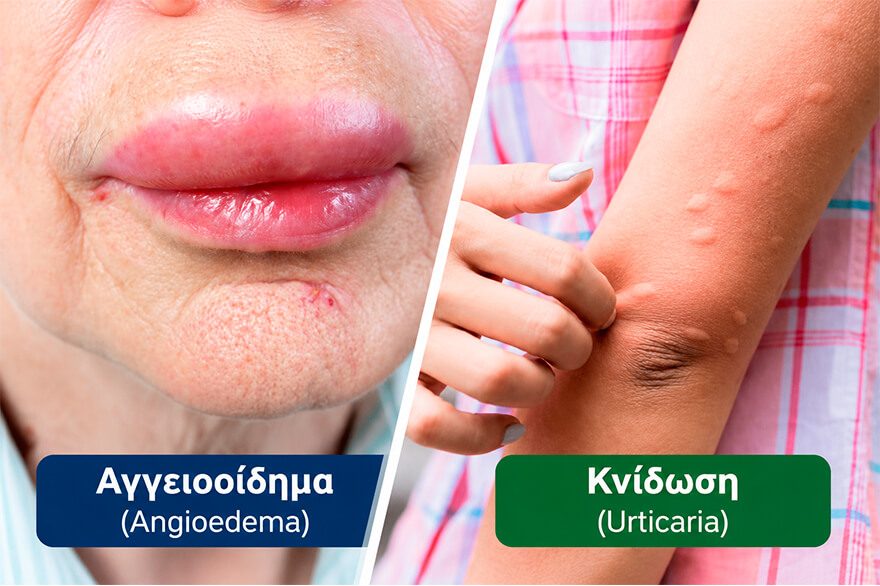
Urticaria – Angioedema
Urticaria
Urticaria (hives) is a common skin condition, with approximately 1 in 5 people experiencing at least one episode during their lifetime, often without an obvious cause. It is characterized by the sudden appearance of wheals (hives) and/or angioedema (deeper swelling, usually affecting the eyelids, lips, or extremities).
Its pathophysiology is associated with the activation of mast cells in the skin and the release of histamine and other inflammatory mediators.
The Key Feature of Wheals: Their “Migratory” Nature
One of the main characteristics of wheals is their transient nature:
Temporary presence: Each individual wheal usually disappears completely within 24 hours without leaving any marks on the skin.
Constant change in location: Wheals may appear in one area, resolve within a few hours, and then reappear elsewhere on the body.
Types and Duration
Depending on the duration of symptoms, urticaria is classified as:
Acute Urticaria: Lasts for less than 6 weeks and may be triggered by factors such as stress, infections, medications, or foods.
Chronic Urticaria: When symptoms persist for more than 6 weeks, further medical evaluation may be required to investigate potential associated or underlying conditions.
Main Principles of Treatment
First-line treatment: Oral second-generation antihistamines are the cornerstone of treatment. When standard doses are insufficient, the allergist may recommend a carefully supervised increase in dosage, up to four times the standard daily dose, in accordance with international guidelines.
Advanced Biologic Therapies: For patients with chronic urticaria who do not respond adequately to antihistamines, modern treatments such as the monoclonal antibody omalizumab can provide excellent symptom control in many cases, offering significant and long-lasting relief.
Short-term use of corticosteroids: Oral corticosteroids may be used only for a short period of time when clinically appropriate for the management of severe acute symptoms, such as during an exacerbation.
Avoidance of aggravating factors: Identifying and, whenever possible, avoiding known factors that may worsen symptoms—such as certain anti-inflammatory medications, infections, or physical triggers such as cold—is an important part of treatment.
Angioedema
When Does Angioedema Require Particular Attention?
Angioedema is a localized, deeper swelling that commonly affects areas with loose tissue, such as the eyelids, lips, tongue, extremities, or genital area. It may occur as an isolated symptom, without wheals (urticaria), or together with urticaria. When associated with urticaria, it is most commonly histamine-mediated.
Evaluation of Isolated Angioedema
When angioedema occurs without urticaria, the clinical approach is different and targeted investigation is required to evaluate two important categories of causes:
Exclusion of Rare Genetic Disorders: Specialized testing may be necessary to rule out hereditary angioedema (HAE). This is a rare but potentially serious genetic disorder, most commonly caused by a deficiency or dysfunction of C1 esterase inhibitor (C1-INH). These episodes do not typically respond to antihistamines or corticosteroids and, when swelling involves the upper airway—particularly the larynx—they can be life-threatening.
Medication Review: The patient’s medication history should be carefully reviewed. One of the most common medication-related causes is the use of angiotensin-converting enzyme inhibitors (ACE inhibitors), which are widely prescribed for the treatment of hypertension.
Treatment Approach
Treatment differs significantly depending on the underlying mechanism:
In histamine-mediated angioedema, such as angioedema associated with urticaria, second-generation antihistamines are the mainstay of treatment. In selected cases, they may be administered at higher individualized doses under medical supervision, while targeted biologic therapies may also be considered for more severe or persistent forms.
Isolated, non-histaminergic angioedema caused by medication requires discontinuation of the responsible medication and, when necessary, its replacement with an appropriate alternative from another drug class under medical guidance.
Treatment of Hereditary Angioedema
Treatment of hereditary angioedema includes:
Treatment of Acute Attacks: Acute episodes can be treated with medications that replace the deficient or dysfunctional protein, such as C1 esterase inhibitor (C1-INH) concentrate, which is administered intravenously and can rapidly halt the progression of swelling.
Alternative targeted treatments include icatibant, a bradykinin B2 receptor antagonist, and ecallantide, a kallikrein inhibitor. These medications are administered subcutaneously. Icatibant can be self-administered by appropriately trained patients, while ecallantide requires administration under appropriate medical supervision.
Short-Term Prophylaxis: Before certain medical procedures, dental procedures, or surgery—where trauma or stress may trigger a severe episode—preventive treatment may be recommended shortly before the procedure. This commonly involves the administration of C1-INH concentrate, depending on the procedure and the patient’s individual risk.
Long-Term Prophylactic Treatment: For patients who experience frequent or severe attacks, the goal of long-term prophylaxis is to prevent episodes and allow patients to live their daily lives with minimal disease burden.
Modern preventive options include berotralstat, an oral plasma kallikrein inhibitor taken once daily, which can significantly reduce the frequency of HAE attacks.
An alternative option is lanadelumab, a monoclonal antibody targeting plasma kallikrein. It is administered subcutaneously, commonly every two weeks during initial treatment, providing an effective long-term preventive option for appropriate patients.
If you or someone close to you experiences unexplained, recurrent episodes of swelling, a specialized allergy assessment together with appropriate laboratory testing—including measurement of C1-INH levels and function—is an essential first step in identifying the underlying cause.